
"Women were playing in every city all over the globe and very much leading the way in many cities. But the way the history is told is that there was like one woman for every 50 guys or something."
There is still a prevailing discourse that labels women in alternative music as anomalies, when the truth is, they have always been a vital part of every scene and genre, with punk being no exception.
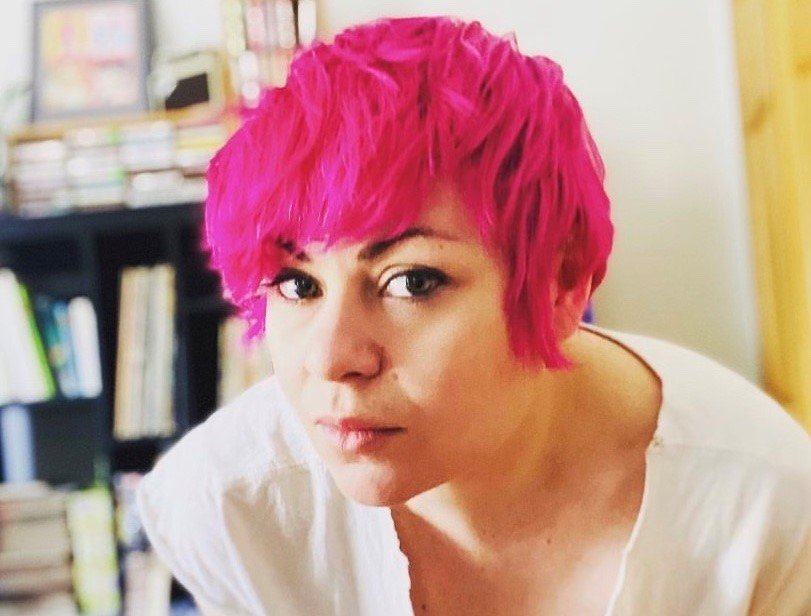
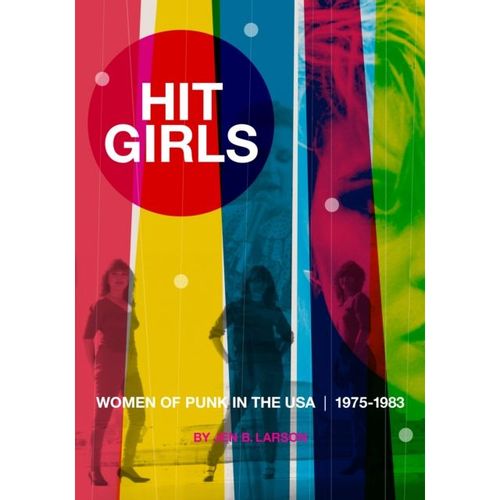
In her new book ‘Hit Girls: Women of Punk in the USA 1975-83‘, author Jen Larson gives timely credit to the women whose legacy would otherwise be lost in the telling of punk’s history.
John Wisniewski spoke to the author about her book that documents the women of the US punk scene from 1975-1983, and asked for her take on the obstacles for female musicians and the importance of telling their stories….
How the book ‘Hit Girls‘ begin- why did you write the book?
“I wrote the book because I think it’s really important that people understand how integral women were to the punk movement’s beginnings. Women were playing in every city all over the globe and very much leading the way in many cities. But the way the history is told is that there was like one woman for every 50 guys or something.
Around 2017, I had been neurotically making lists of bands from the ‘70s/’80s that had women in them. The list was so long and it wasn’t enough to just keep a bunch of band names in a spreadsheet or on index cards taped to my closet– their stories needed to be told. I had started a blog featuring various songs by bands I liked and I couldn’t find that much information on a lot of them. I found myself writing “legend has it…” or “apparently…” or “no one knows the real story, but…” and stuff like that a lot. I had an urge to find answers to some of my questions and my friend Todd Novak suggested I write a whole book about it, and I thought that was a good idea. It felt like a pipe dream at first, but I kept at it, and now here we are.”
“One of the purposes of ‘Hit Girls‘ is to prevent the erasure of this history. Women tend to get omitted from all sorts of histories that they played significant roles in. Scholars have figured that among other things, this is a result of who is keeping records. The more that women are involved in writing our history, the more likely we are going to see women represented in it. This, in turn, gives young kids examples of women doing things they may otherwise grow up only thinking guys do. The book is also an act of gratitude to show appreciation to the women of the ‘70s who didn’t have those role models and did it anyway.”
What did the female punk rockers face, in trying to present their music?
“It varied for different women in different environments. In a lot of scenes, women seeing other women performing was inspiring and other women were encouraging toward one another. A lot of guys were supportive and excited about women’s participation as well. It was almost utopic– men and women working together in artistic parity and traditional gender roles almost dissipated.
Then there were other places and situations where they were denigrated or had to fight for respect. There were places where women’s music was just as good or better than some of the guys’ music (in my opinion!), but they weren’t being taken seriously. For example, the Dishrags were teenagers playing in Vancouver and had really great songs– some serious bops– but when they were booked at a local battle of the bands, they were billed as openers instead of serious contenders in the contest. They experienced audiences throwing trash at them and booing so often that they have a hard time differentiating which shows this happened at and which it didn’t.”
What did audiences think of women like Alice bag, Penelope Houston and Texacala Jones?
“I’m sure there were various responses. These three are all artists who feed on the energy of a room and then give it right back. Based on video evidence and other commentary from people who were there, audiences loved them and encouraged them and cheered them on. The Bags and Avengers continued to play shows until the bands broke up. Tex and the Horseheads played through 1986. They’ve all always had considerable followings.”
Why was this explosion of women punkers inevitable during the 70s and early 80s?
“The explosion of women participating in punk was inevitable during the ‘70s and early ‘80s because of the social politics of the moment. Women were feeling more empowered in general. This period was at the tail end of 2nd wave feminism and in some no-man’s land between that and the 3rd wave of feminism. Not all these artists necessarily wanted the fact that they were women to be relevant to their work– in fact many of them didn’t. Many of them wanted to be taken seriously as artists and wanted their work to speak for itself.
Whether or not their gender was important to their identity as an artist or their work, they all wanted to be creative without asking permission. Women didn’t want to be told they couldn’t and weren’t allowed to do something just because they were women. They were also exploring activities and lifestyles outside of domesticity which led to them being creative on their own terms. It was a direct result of women being more independent in general.”
‘Hit Girls’ by Jen Larson is available now! You can order online from HERE.
Follow the author Jen Larson on her Socials
Need more Punk In Your Life?

Exclusive – The video premiere of SOLO 1981’s ‘Saturday night’!
The solo project of Stefano Giambastiani – vocalist, guitarist, songwriter, and frontman of Acid Brains – SOLO 1981 has, since 2014, carved out a distinct

Album Review: Crimson Riot Release ‘Third Time’s A Charm’
Las Vegas punk trio Crimson Riot officially formed back in 2017, but they have been playing music together for over 15 years. The band are

Album review: Dutch punks Radio Cyanide release their first LP ‘Frogs’
Founded in, 2024, Radio Cyanide from Groningen, the Netherlands have plenty of musical experience from their previous bands! Debut album ‘Frogs’ is being released on

EP review: Diagnostics – ‘Thoughts To Forget’
Miss the glory days of Epitaph and Fat Wreck Chords? Diagnostics are just what the doctor ordered. Bridging the gap between skate-punk and melodic hardcore,

EP review: Flatwounds – ‘Chain Of Command’
Rare are bands that draw influence from both underground hardcore and arena-sized hard rock/metal bands, but upstate New York quartet Flatwounds do exactly that, and

EP review: Mass Hallucination unleash their self-titled debut!
Opening track ‘Lacerated’ rides in on a wave of distorted feedback and belts along with hardcore punk fury and some seriously two-step worthy crunchy guitar
John Wisniewski is a contributing writer for amfm magazine, LA Review of Books, Punk Globe magazine, and Skratch Punk magazine.
He currently resides in long island NY USA.


Did you know that we are 100% DIY? We run our own game. No one dictates to us, and no one drives what we can or cannot put on our pages – and this is how we plan to continue!