Punk Features Punk News

Interview: Molly Tie, author of ‘Rebel Grrrls: The Real Story of Women and Punk’

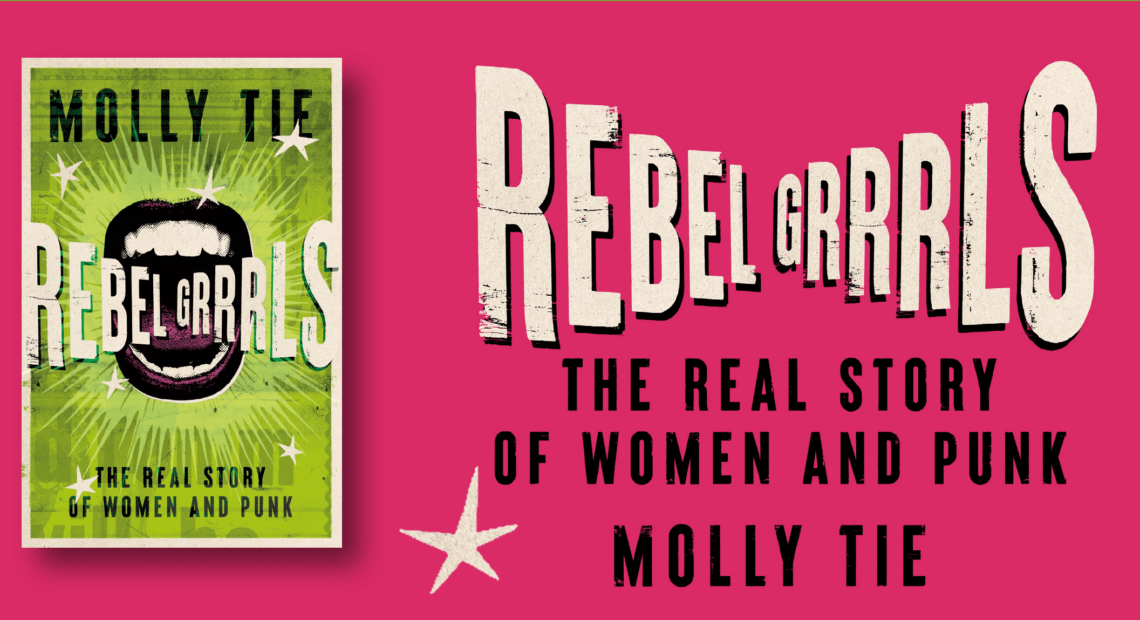
A genuinely fascinating book that HAD to be written, this is the insightful and hitherto untold story of female Punk fans...

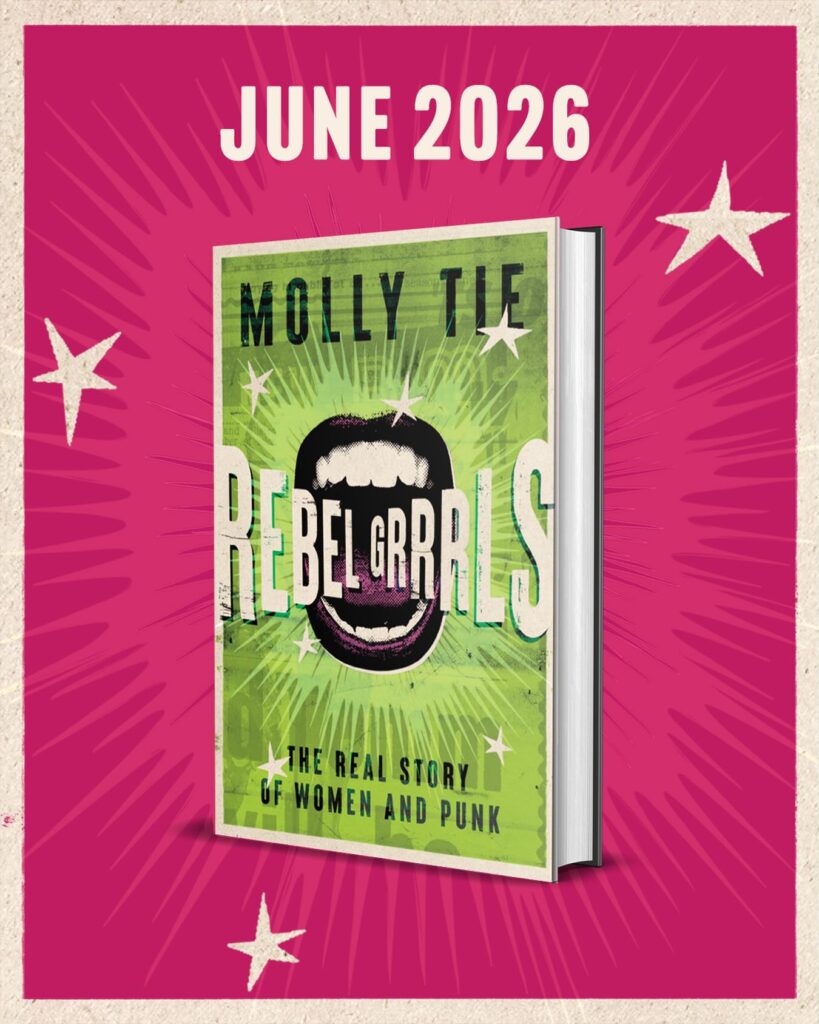
Our regular readers will recall many compelling articles by Molly Tie, Punktuation! Magazine‘s UK Editor for two years. It’s a pleasure to welcome Molly back for this interview about her essential new read – ‘Rebel Grrrls: The Real Story of Women and Punk’ – to be published by Omnibus Press on 11th June 2026.

From the gritty streets of 1970s London to the sun-soaked beaches of 2000s California, ‘Rebel Grrrls: The Real Story of Women and Punk’ is a raw and exhilarating exploration of rebellion and identity through the eyes of its fans. This book goes beyond the musicians, focusing on the women who shaped the scene from the crowd – turning gigs into acts of defiance and using music as a tool for belonging.

Molly Tie examines what the movement has meant to millions of fans, setting their experiences within a wider cultural and political landscape. What is it like to be a woman at a gig? Which bands and songs truly reflect the female experience in a male-dominated space? And how does our connection to alternative music change when powerful figures face allegations of abuse?

First of all, a huge thank you for writing this fascinating and essential book Molly! As you know, here at Punktuation Magazine we’re not only fervent supporters of female punk artists, but also for gigs to be truly inclusive spaces for fans. There’s still a way to go to ensure that newer bands get proper recognition and the venues are safe and welcoming. You have a great deal of knowledge about punk in relation to politics and culture, as we have read in your articles on your website, Punk Rock Philosophy.

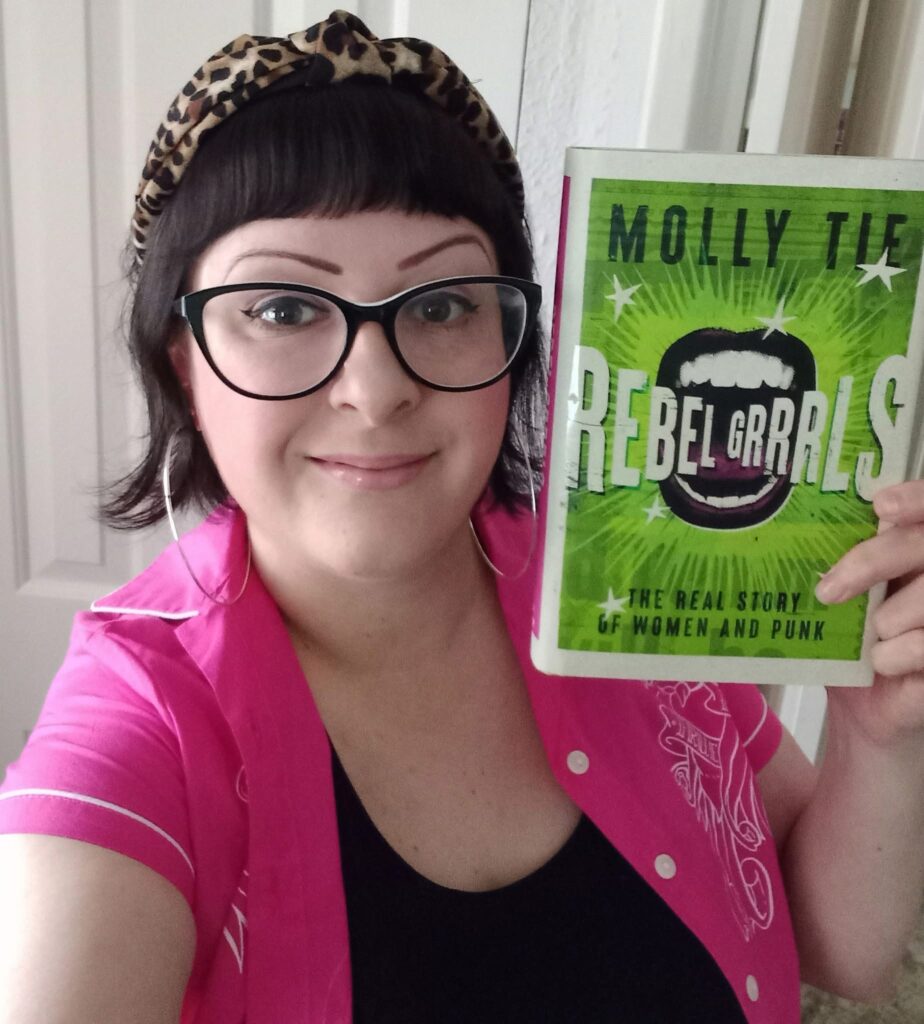
Molly Tie with Rebel Grrrls book
Author Molly Tie

1. Why did you decide to write a whole book about the history of women in Punk?

“Thank you Ruth! At first wasn’t going to be a book… I’d started writing a small blog about women in music. It wasn’t Punk specific; I wrote a lot about 60s girl bands and other stuff I liked, but as a Punk fan, I was starting to veer towards writing more exclusively about Punk. The blog was going to be about female Punk musicians that I liked – a series of profiles of the usual suspects, I would say! Siouxsie Sioux, Debbie Harry, Poly Styrene, Kathleen Hanna – and then as I was writing that, I felt a bit unfulfilled, because what I really wanted to do was move beyond covering the same public figures, and think more reflectively around how those figures may have influenced fans. That started getting me to think about role models, and Punk’s influence on fans, which snowballed into wanting to write more from the fans’ perspective – and think about how not just the musicians but the songs and the gigs and the whole culture around Punk has been for women.”

 “I knew quite early on that I wanted it to be the good, the bad and the ugly – more of a critical friend – because I didn’t want to put Punk on too much of a pedestal. I’d read a lot of books about Punk which seemed to be cherry picking of some of the positive aspects, without much holding to account where Punk falls short. By that time, I’d been working in the Violence Against Women and Girls sector for quite a while, so analysis around misogyny and sexism and inclusivity is really important to me, and I wanted to go down that route more. It became a book because of the length – the amount of things that I wanted to cover – every major era and place from the 70s through to now! There was so much to say, linking it to the wider socio-political culture, and I and wanted to include the oral history element of speaking to fans – and that’s how it became Rebel Grrrls.”

Something I really like about the book is how it is broken up into logical sections following the time period from the 1970s (and even slightly before that) up to the present day. I think it makes it so easy to read and understand and link back – you’ve absolutely nailed it on the history side!

“Thank you! Funnily, it was suggested to me at one point that it shouldn’t be organised chronologically. Why don’t we organise it by theme? But I resisted that, because I think it would be difficult to work out how one thing led to another. I think it works chronologically because the story of Punk did unfold that way, in the sense that one thing was built upon, adapted and changed according to the context for the next wave. People were picking the things that they thought the previous generation got right and trying to get rid of the things that they thought maybe weren’t reflective of the space they were in. If you wrote ‘England’s Dreaming’ for each era, and put it in one book, the book would be enormous! It’s meant to be bit a breezy history, but I’m fascinated about all areas of Punk and all eras, so there wasn’t a time that I didn’t want to include!”

2. The stories of female Punk fans are an integral part of the book, and a critical part of the genre’s history which hasn’t previously been explored. Did you discover anything unexpected during your interviews?

“Yes – quite a lot! Each individual experience in Punk is limited in scope, as we weren’t all ensconced in all of the scenes for all the eras. Hearing from people who were there at the time gave me more of an insight than I could have just by reading about it. Speaking to people who were in Washington, DC in the 80s gave me a better perspective on that time. There were some really inspirational stories – Andrea’s family came to America from Chile in the 80s, and she experienced a lot of racism at school and in her neighbourhood and wider community, but not at Hardcore Punk shows. There she felt included, validated and safe. Hearing those stories was really powerful.”

“There were also interesting bits of trivia that I didn’t know – for example, contributor Dr Francis Stewart, an expert on Straight Edge punk and culture talked about Mormon Straight Edge. They belonged to the Mormon church, they were into the Hardcore punk music, and they were very militant about enforcing Straight Edge – and there was even violence attached to that scene! There were lots of surprising things happening all around the world, from a very robust Mexican Ska-punk scene, through to one of the contributors from Italy talking about how the actions in her scene were more around getting out on the streets to fight fascism. and stuff like that. It was a constant stream of people doing much more inspirational stuff then I’ve ever done!”

3. Fascinating indeed! People see Punk as a culture of rebellion – an attitude that is expected in boys, but which is very much disapproved of when girls rebel! Has Punk encouraged women to break out of these chains?

“I think it has. We know Punk’s not perfect, but I do think it’s been transformative, and one of the most important social and music movements there has ever been. It represents a certain type of rebellion for women. There are academic sources about women in Punk, talking about how they’ve got a double rebellion – they’re rebelling in the sense that anyone in punk is rebelling against a prevailing, more subservient popular culture, so there’s that rebellion that everyone into Punk is involved in just by nature of being part of the scene. But then they’ve got this additional element that they’re rebelling against very traditional ideas of femininity, and how women should be seen and how they should behave, and also that they might have to rebel against the men in that scene.”

“For example, the Riot Grrrls wanted to break away from the macho Hardcore scene of the 80s. Their rebellion is multi-layered, because they had to rebel within Punk, and that can be quite uncomfortable if you challenge people in your social group who are are part of a community that you also want to be part of. I think there’s a lot of loaded rebellion for women – there are more avenues in which we have to rebel in order to be seen, to be heard and to be validated. But ultimately, it’s not seen as desirable for women to be angry. And one thing that Punk often is, is angry! It’s not nihilistic anger (well, some of it is), but the Punk that I like has productive anger, anger that leads to action. And it is not considered comfortable, even now, for women to be angry…”

4. I very much agree. There’s a theme throughout the book of women fighting to be heard. Obviously, this is as much of a problem in society as in the Punk world! At the start, those who shocked people the most were known for their physical appearances, but seldom for anything they had to say. Do you believe this has changed at all across the decades?

“Yes, I do think so. When we got to Riot Grrrl, that was obviously very female-centric. Not just in terms of how those in the scene might have chosen to dress, but also in terms of the band representation, and lyrical content that was very female-centric, thinking about female friendships, female reproductive rights, and aspects of our bodies such as menstruation justice. That goes back as far as the 90s, but I believe there was a roll-back by the time we got to the late 90s, as Riot Grrrl started to wind down in intensity. Mainstream Punk was replaced by Pop punk and then Emo, when I think women’s voices were quite marginalised.”

“Not so much in the DIY scene, but in terms of the book, I’m thinking about what mainstream Punk would have looked like, particularly for adolescents accessing it at the time. As the book suggests, that was quite a difficult, challenging time for getting women’s narratives heard. The content of the songs was very much around ‘this is how boys feel, this is how men feel and this is how they are experiencing the world’. I definitely think that has changed now. There is more mainstream discourse around toxic masculinity, and we’ve got the Me Too movement and words like ‘mansplaining’. I think that that has empowered a new generation of punks to be able to think about how they would represent those things in their songs.”

5. There’s also the theme of legitimising women’s anger – something that’s generally squashed by a patriarchal society. Do you agree that Punk has encouraged women to tap into this emotion?

“Yes, I think it encourages women to tap into anger because Punk encourages people to tap into their anger, and I think it legitimises anger as something that is valid and appropriate to feel, and again, something that can be productive. I’ve never personally listened to a lot of nihilistic Punk, the ‘burn it down’ kind of thing. I’m more interested in ‘burn things down because you want to build something better in their stead’ – Punk that comes from a place of caring about other people. Although I’m not a massive fan of Johnny Rotten now, I do like what he said about ‘God Save the Queen’; “You don’t write a song like that because you hate people. You write it because you love people and you’re sick of seeing them mistreated.” I think that’s where the anger in Punk is particularly poignant and powerful, when it comes from people not just thinking about themselves but thinking about their community, or thinking about other people around the world, and not wanting them to be mistreated.”

“I think women in Punk have definitely been able to benefit from seeing that it does legitimise anger, and also, everything about Punk allows that to be expressed. Even the fashion is a means of expressing your anger and your opposition to the world. One of the contributors to the book, Christie, said that when she was into Minor Threat and Straight Edge bands and some Emo, she wanted people to know ‘I’m not like everyone else – I’m not this cookie cutter person’. A lot of the contributors said, ‘we want people to know we’re into Punk, because then they’ll know there are certain things we don’t agree with and there are certain things we stand for’. That’s something that’s been really positive about Punk and for women, especially in the DIY aspect the the music, which provides another outlet for women’s anger. You would hope, because there is a lot for women to be angry about, that this then falls on receptive ears. If you’re singing about the challenge to reproductive rights for women in the world, you would hope that someone that you’re singing that song to in a Punk context is going to be receptive to that. They’re not always. And that’s another thing I talk about in the book, because it’s not a utopia, but I think the Punk scene as a whole is supportive of it.”

6. Many women in the scene have suffered at the hands of abusive men – musicians coerced by managers or record labels, and both artists and fans assaulted and insulted at shows. Now that women feel more empowered to speak out, do you hope that the tide may turn?

“I always hope – you’ve got got to be hopeful. However, I think that there are still many barriers and many challenges around this. It’s a big topic further on in the book, and as we get into more modern times, there are other avenues for women to talk about their experiences such as social media and the internet, things that you wouldn’t have had in the 70s. This has given more opportunities for women to speak up, speak out and gain support, either professionally or socially. Unfortunately, the idea that Me Too means that women are always believed and that predators are removed from the scene, is incorrect. Later in the book, I argue this is something that the scene – venues, individual people, record labels, fans and consumers – need to think about, and how we manage those scenarios. One of my real bugbears is when someone is seen to be racist or misogynistic or discriminatory in some way, people say, ‘well, they’re not really punk, because if they were, they wouldn’t be that way’. So all Punk is anti-racist, anti-sexist, and if you are any of those things, you’re not Punk? The issue with that is that it passes the buck. If that person is still in the scene, they’re going to gigs and they’re on social media, engaging with other punk fans on the message boards, then they’re in that space. Whether you call them a Punk or not is a bit of a moot point, as they still pose a risk to the people around them.”

“Later in the book, I do challenge the idea of zero tolerance and start saying ‘but what does that actually look like and what does that mean?’ It will have to start from acknowledging and facing the fact that the statistics around violence against women are incredibly stark, and they exist in the Punk scene as much as they exist anywhere else. I’m not saying it’s specifically a Punk problem, but it’s something that definitely happens – it’s not something Punk is immune from in a way that a lot of people might seem to think it is…”

Yes, I agree. It certainly it hasn’t been my friends and my experience that we are believed when abusive things happen. We’re generally not believed, the perpetrators remain welcome in the scene, and everyone’s seemingly fine with them.

“Especially if they are people that are already relatively well thought of or beloved in the scene. On a larger scale, if it’s about, let’s say musicians that are very well known, I think how a lot of how people respond to allegations against that person depends on how they feel about the person the allegations are being made about. There’s a whole other book that I’m sure other people have written or will write about how we put (mainly) men on a pedestal who write songs that we like; the tortured genius, the tortured artist, the good songwriter who somehow doesn’t have to play by the same rules as everybody else. I don’t think that that is true and to me that’s something Punk should always challenge. Whatever songs you’ve written, whatever album you’ve written, whatever band you’re part of, that doesn’t mean that you get to behave with impunity in a way that the bloke down the street doesn’t get to act. The standards should be the same, if not higher.”

7. The Riot Grrrl movement of the 1990s brought feminism loudly and clearly into Punk. Do you believe that the genre wouldn’t be what it is now if that hadn’t happened?

“That’s a really good question! Yes, I think Riot Grrrl has contributed to how the scene is now, and it would be different if it hadn’t existed. I think that Riot Grrrl came about as a way to redress the imbalance that was in 80s American Hardcore. Disgruntled scene members who thought ‘if we can’t change it from the inside of Hardcore because it is a boys club’ – and I say that as someone that really loves American Hardcore! – ‘we will have to start our own parallel scene and build that from the ground up to see if a different type of scene is possible.’ I think that has inspired generations to continue to pick up instruments to get involved in magazines. There’s a whole other book to be written about how ‘zines have kept this subculture alive and empowered so many people, and that was a huge part of Riot Grrrl, forming networks via writing. It has inspired subsequent generations to learn from what the Riot Grrrls did and show that it is possible to build these things – and you don’t need a man to do them! But now, because we’re much more intersectional as a society, I think younger generations expect more from the spaces that they access, which is fair enough.”

“We can now build on some of the good aspects of the Riot Grrrl tradition and also acknowledge that there are some legitimate criticisms to be made. It wasn’t seen as particularly ethnically diverse and not a lot was done to reach out to encourage women of colour to get involved in the scene. Sometimes it’s dismissed as a middle-class, white girls’ scene. It was trauma-informed in the sense that it knew women experienced trauma, but it spent a lot of time talking about and encouraging people to explore that in ways that now we would say wouldn’t be a safe space to do so. There should be qualified professionals and people around to support. I think the benefit of Punk developing is that each wave can learn from the mistakes of the previous one and combine it with a different social and political context to create something better. It can just keep going and going and going. The gift that we can give to the next generations is to say, ‘now it’s yours, you do with it what you think you should do’, because I didn’t get it right and my mum’s generation didn’t get it right, but you could take that forward. You won’t get it all right, but if you keep Punk going, then the generation after you will have that gift.”

Thank you so much for your time, Molly, and for writing an absolutely brilliant and insightful book. I’m looking forward to the next one – there are lots of other intriguing concepts in Punk to explore! All the best with the upcoming book tour as well as your appearance on the Literary Stage at Rebellion Festival in August!

Rebel Grrrls: The Real Story of Women and Punk’ is a genuinely fascinating book that HAD to be written – the (until now) untold story of female Punk fans and what the movement meant to them across the decades – which finally fills this gap in Punk ‘her’story!

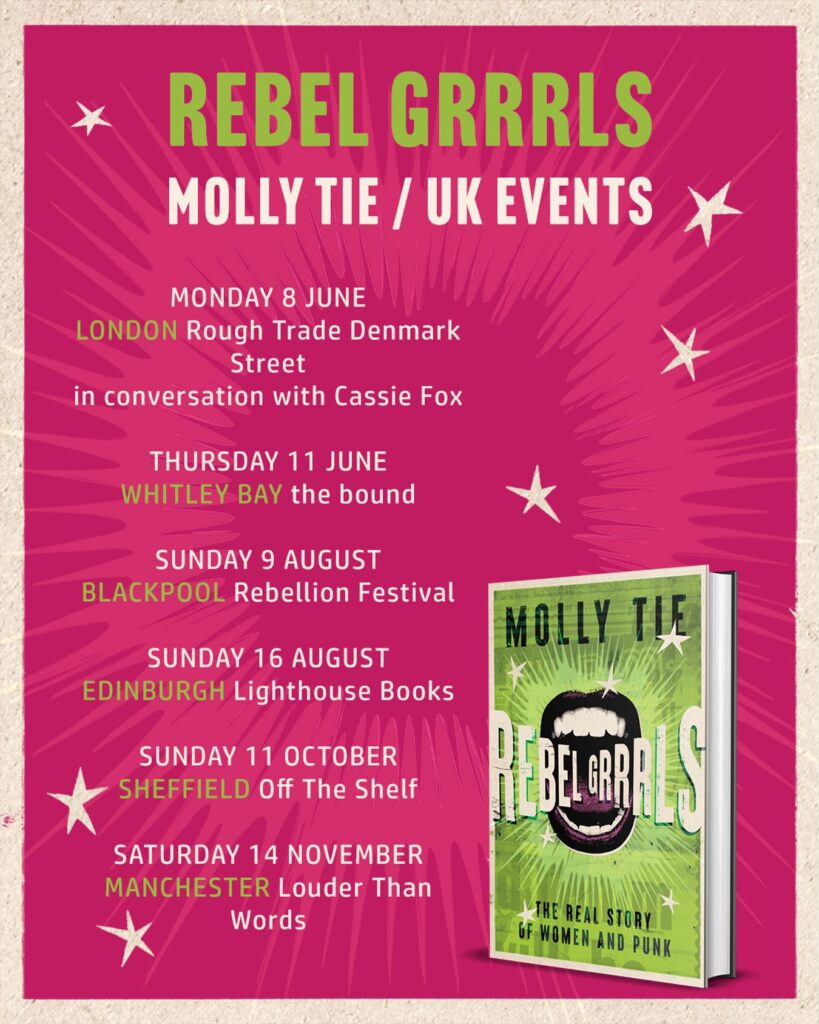
Molly Tie will be appearing at the following stores and festivals, where you can hear more of her insights into the book, and pick up your signed copy:

Molly Tie Rebel Grrrls book launch events 2026 poster

Rebel Grrrls: The Real Story of Women and Punk’ is available to order from Omnibus Press HERE, and at all good high street and online booksellers from 11th June.

Molly Tie is a music journalist with over 15 years of feminist campaigning and public speaking under her belt. Tie has written extensively on punk and women’s role in music for publications like Vive Le Rock, Loud Women and her own site Punk Rock Philosophy. Her musical herstory series for Loud Women gained acclaim. As UK Editor of Punktuation! from 2022 to 2024, she shaped the discourse around the movement’s legacy. Beyond music, Tie has worked in the Violence Against Women and Girls (VAWG) sector, specialising in domestic abuse, sexual violence, and child protection training.

Follow Molly Tie on Her Socials:
Need more Punk In Your Life?
Share This Story!